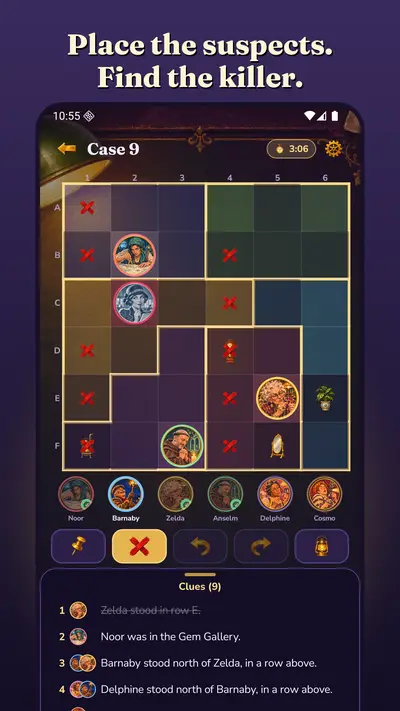
Detective sudoku is a small family of logic puzzles that keep sudoku's one-per-row, one-per-column rule and replace the digits with a crime. You place suspects on the floor plan of a building, the clues are witness statements, and the solved grid names the killer.
What stays from sudoku
The grid, and the rule that makes sudoku work: each row and each column takes every “piece” exactly once. Here the pieces are people, so on a 6×6 plan there are six suspects, one in each row and one in each column. The boxes of sudoku become rooms of different shapes.
What is new
- Written clues instead of given digits. You start with an empty plan and a sheet of statements such as “Cosmo stood in column 3” or “Nobody was in the Stage”.
- A question at the end. The victim lies in one room, and exactly one suspect is in that room. Solving the grid answers “who did it?”.
- Obstacles. Furniture and the victim block cells, so rooms are less roomy than they look.
- A story. Each case has a place, a cast with jobs, and a motive you read once the case is closed.
How it compares with other puzzles
| Puzzle | You fill in | You reason from | The result |
|---|---|---|---|
| Classic sudoku | Digits 1–9 | Digits already on the grid | A full grid |
| Killer sudoku | Digits 1–9 | Sums of cages (arithmetic) | A full grid |
| Logic grid puzzle | A yes/no table | Written clues | Who owns what |
| Murder sudoku | Suspects on a floor plan | Written clues about position | The killer |
Despite the similar name, killer sudoku has nothing to do with crime: its “killer” is the difficulty of the cage sums. If you like deduction from written statements more than arithmetic, murder sudoku is the closer match. If you want the classic cross-out table, try our logic grid puzzles.
What a case looks like





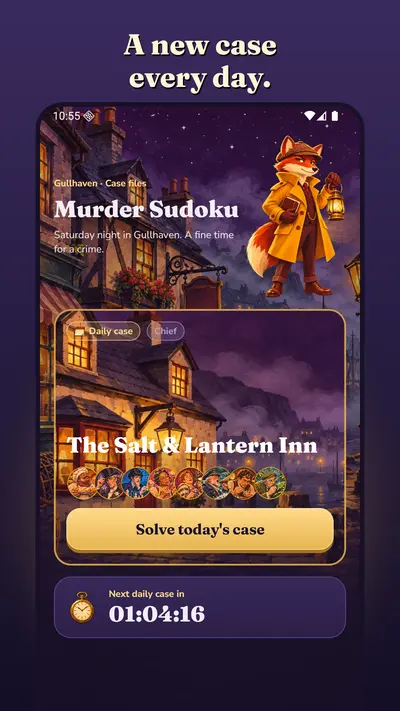
Our cases are set in Gullhaven, a foggy harbour town with an inn, a lighthouse, a cinema, an abbey, a night train and seven more places. Thirty-six townspeople take turns as suspects, and Inspector Fennick, a fox in a yellow coat, keeps the files.
How hard is it?
The daily case grows through the week:
- Sergeant, 6×6 (Monday to Wednesday): direct clues and simple pairs. A first case takes about five to ten minutes.
- Inspector, 7×7 (Thursday, Friday, Sunday): more people, fewer gifts, sometimes a “what if”.
- Chief, 8×8 (Saturday): long chains where one placement unlocks the next.
No case needs guessing. Each is generated together with a proof that it has one answer reachable by logic. New to it? Read the rules with a solved example first.