If you like sudoku for the feeling of a grid slowly locking into place, there is a whole family of puzzles built on the same idea: a few fixed rules, one answer, no guessing. Here are eight worth knowing, what each one trains, and where to play four of them free.
| Puzzle | How it works | Why a sudoku fan might like it |
|---|---|---|
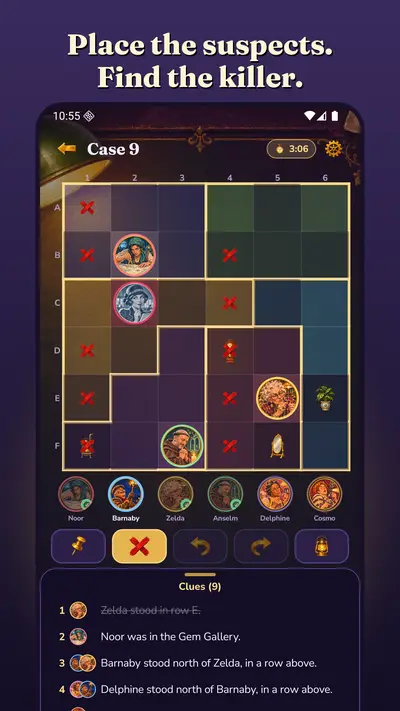
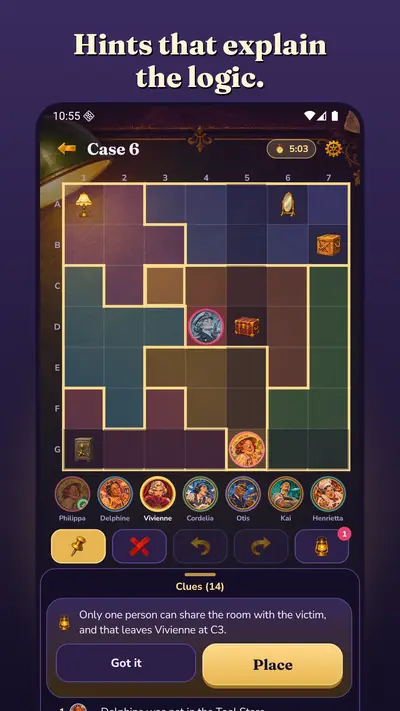
| Murder sudoku | Suspects on a floor plan, one per row and column, placed from written clues. The result names a killer. | Deduction from sentences, with a story |
| Star battle | Place stars (or queens) so each row, column and region holds the same number and none touch. | The purest row-column-region logic after sudoku |
| Sun and moon puzzle | Fill a grid with two symbols: equal numbers in every line and never three in a row. | Fast, visual, good on a phone |
| Logic grid puzzle | Work out who owns what from a list of statements, crossing boxes in a table. | The classic for people who like clues in words |
| Killer sudoku | Sudoku with no given digits: cages show the sum of their cells. | Sudoku plus mental arithmetic |
| Kakuro | A crossword of sums: each run of cells adds up to its clue, with no digit repeated. | Arithmetic and combinations |
| Futoshiki | A Latin square with greater-than and less-than signs between some cells. | Chains of inequalities, much like “north of” clues |
| Nonogram | Shade cells from number clues for each row and column until a picture appears. | Counting and overlap, with a reward at the end |
If you want the same logic without digits
Star battle and the sun and moon puzzle keep sudoku's skeleton: every row and column must satisfy a count. Nothing has to be added up, so they play well in a spare five minutes.
If you want words instead of numbers
Murder sudoku and logic grid puzzles hand you statements to interpret. Murder sudoku keeps the grid and the one-per-row-and-column rule, so sudoku habits carry over directly: a placed suspect closes a row and a column exactly like a placed digit. The difference is that every case ends with an answer to a question, “who did it?”, and not only a full grid.





If you want more arithmetic
Killer sudoku and kakuro add sums. Despite the name, killer sudoku has no crime in it. Futoshiki sits in between: no sums, only “bigger than” signs, which feel a lot like the “north of” and “west of” clues of a murder sudoku case.
What they all share
- One answer. A well-made puzzle of any of these kinds has exactly one solution.
- No guessing. If you are stuck, a rule or clue has more to give.
- Elimination first. You mostly prove where things cannot be. What is left is the answer.